Lab 15 – Response Playbooks & Workflow Design
Build structured response playbooks for common attack patterns and design workflows that accelerate triage and containment.
Objective Lab goal
This lab focuses on designing structured response playbooks for common attack scenarios. You’ll build workflows for brute‑force attacks, suspicious DNS activity, malware alerts, and lateral movement, then integrate them into your SIEM.
- Outcome 1: Response playbooks created for four attack types.
- Outcome 2: Workflow diagrams designed for each scenario.
- Outcome 3: Playbooks integrated into SIEM automation.
- Outcome 4: Documentation updated with response logic.
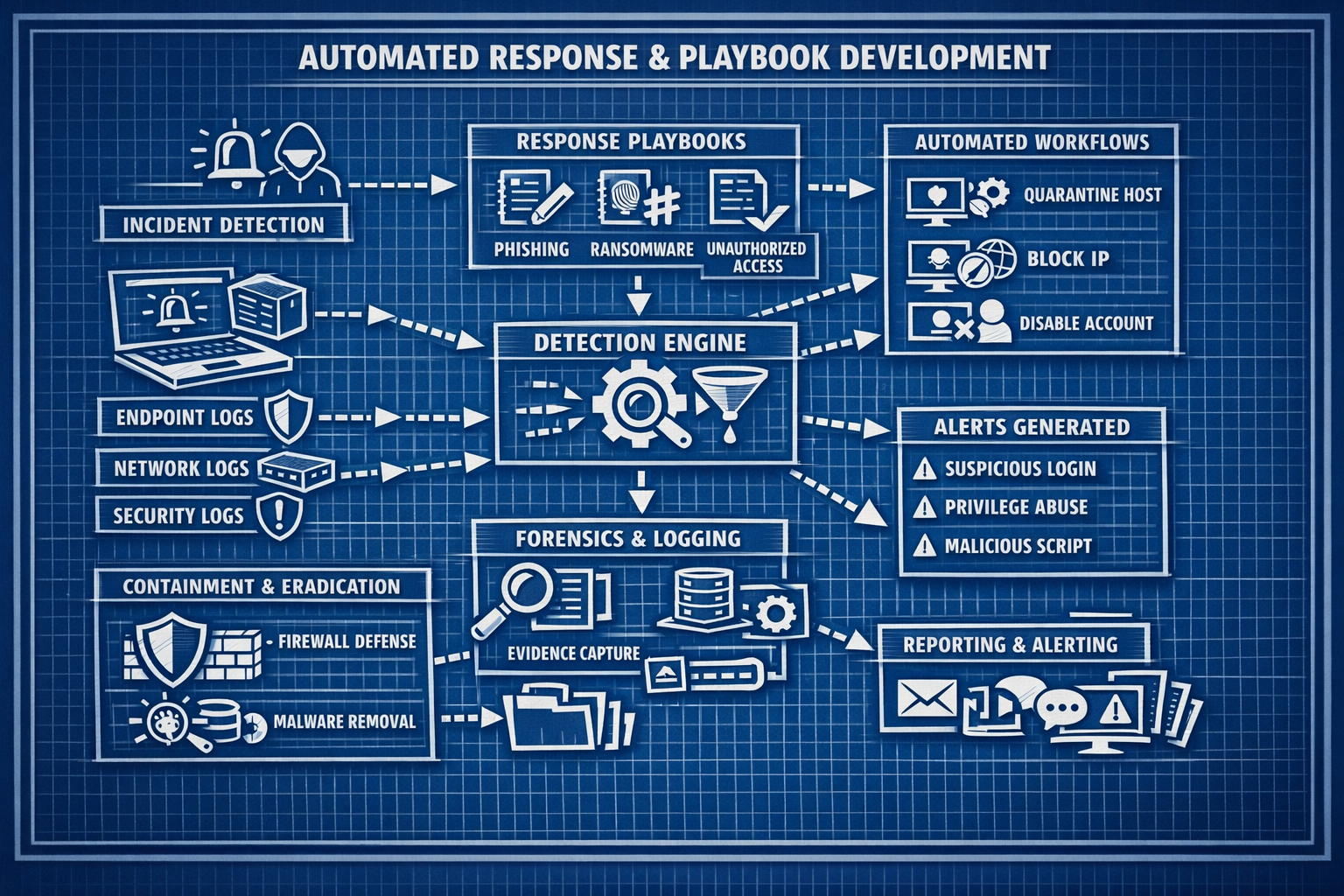
Lab 15: Designing structured response playbooks for common attack patterns.
Deliverables End‑of‑lab checklist
- DL15.1: Brute‑force response playbook.
- DL15.2: Suspicious DNS response playbook.
- DL15.3: Malware alert response playbook.
- DL15.4: Lateral movement response playbook.
- DL15.5: Workflow diagrams and documentation.
Lab Steps Step‑by‑step instructions
Step 1 – Build Brute‑Force Response Playbook
~45 minutes- Define triggers:
- Failed logon spikes
- Password‑spray patterns
- Define actions:
- Disable account
- Block source IP
- Notify admin
- Create workflow diagram.
Step 2 – Build Suspicious DNS Response Playbook
~45 minutes- Define triggers:
- Queries to known malicious domains
- High‑entropy DNS requests
- Define actions:
- Block domain
- Check process responsible
- Run enrichment
- Create workflow diagram.
Step 3 – Build Malware Alert Response Playbook
~45 minutes- Define triggers:
- Defender malware alerts
- Suspicious process behavior
- Define actions:
- Isolate host
- Collect logs
- Scan system
- Create workflow diagram.
Step 4 – Build Lateral Movement Response Playbook
~45 minutes- Define triggers:
- Unusual SMB traffic
- Remote service creation
- Unexpected admin logons
- Define actions:
- Disable compromised account
- Block suspicious host
- Review authentication logs
- Create workflow diagram.
Reflection What you should understand now
- Structure: How playbooks standardize response.
- Speed: How workflows accelerate triage.
- Consistency: How automation reduces human error.
With structured playbooks in place, you’re ready to validate your hunting and response logic in Week 16.